


For this reason, foundation-related concerns should be evaluated carefully rather than treated as a simple cosmetic concrete problem.
What Does Foundation Leveling Mean?
The term “foundation leveling” can describe several different types of corrective work depending on the construction of the building.
A property may contain:
- Slab-on-grade foundations
- Raised foundations
- Crawl spaces
- Concrete perimeter foundations
- Footings
- Interior support systems
- Foundation walls
The appropriate correction depends on which component has moved and why.
Our first priority is determining whether the concern involves a structural foundation, a nonstructural concrete slab, or another building component.
Possible Signs of Foundation Movement
Foundation movement may present itself in many ways.
Property owners sometimes notice:
- Sloping floors
- Interior wall cracks
- Exterior cracks
- Doors that begin sticking
- Windows that become difficult to operate
- Gaps around trim
- Uneven floor transitions
- Separation between building materials
- Changes around porches or attached concrete
These symptoms do not automatically prove a serious foundation problem. Buildings can develop cracks and movement for many reasons. A proper evaluation is necessary before deciding on repairs.
Why Foundations Move
Ground conditions play an important role in foundation performance.
Potential factors include:
- Expansive soil
- Soil shrinkage
- Poor drainage
- Erosion
- Improperly compacted fill
- Plumbing leaks
- Long-term settlement
- Moisture changes
- Hillside conditions
- Changes in surrounding grading
Structural loads and original construction methods can also influence how a building responds.
Foundation Leveling Is Not the Same as Sidewalk Leveling
A sidewalk panel can often be treated as an independent slab. A structural foundation requires considerably more analysis.
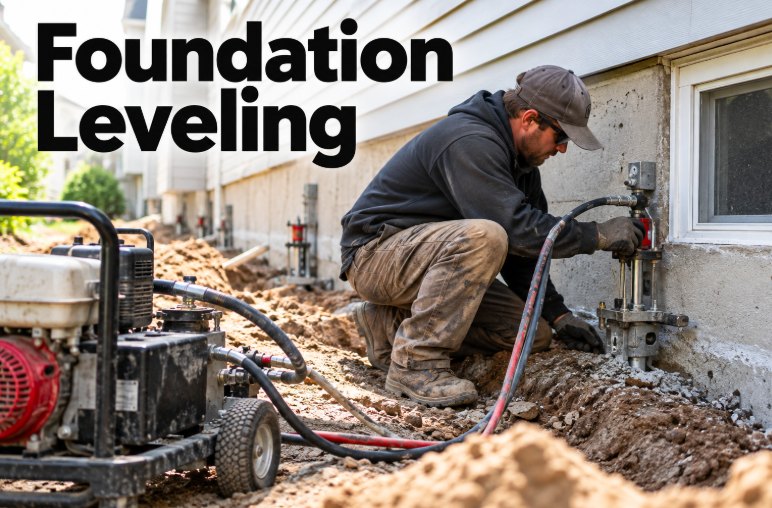
Corrective work may involve specialized underpinning, piers, supports, stabilization systems, lifting procedures, or other engineered solutions.
The method must reflect the type of foundation, amount of movement, soil conditions, and structural requirements.
Evaluating Elevation Changes
Foundation assessment may involve comparing elevations in different parts of the building and reviewing visible signs of movement.
The purpose is to understand the pattern rather than focusing on a single crack.
For example, changes concentrated in one area may indicate a different condition from uniform long-term settlement throughout a structure.
When engineering input is appropriate, that recommendation should be made before major structural work proceeds.
Drainage and Foundation Performance
Water around a foundation deserves attention.
Poor drainage can saturate certain soils, contribute to erosion, or create inconsistent moisture conditions around a structure.
Property owners should maintain gutters, downspouts, surface drainage, landscaping, and plumbing systems so water does not continually concentrate beside the foundation.
Correcting drainage does not automatically reverse existing movement, but it can be an important part of an overall foundation maintenance plan.
Foundation Stabilization and Lifting
In some situations, a repair plan may focus primarily on stabilization rather than attempting to return every portion of the building to an original elevation.
In other circumstances, controlled lifting may be considered.
The appropriate objective depends on the building condition and structural limitations. Excessive or poorly planned movement can affect plumbing, drywall, finishes, framing, and other components.
That is why foundation corrections should be based on site-specific analysis.
Slab Floors vs. Structural Foundations
Sometimes homeowners believe their foundation is sinking when the actual problem is an interior slab that has settled within a stable perimeter foundation.
These situations require different repair methods.
Identifying exactly which concrete element moved is one of the most important steps in developing an appropriate repair strategy.
Get a Foundation Movement Evaluation
If you are seeing sloping floors, unusual cracks, changing door alignment, or other possible signs of foundation movement, arrange an evaluation before assuming the property requires complete foundation replacement.
A careful assessment can help identify the affected area, possible contributing conditions, and the repair options that may be appropriate for the structure.